CGS Engine: Advanced Quant-AI Trading Framework
Comprehensive Technical Documentation & Implementation Guide
Version: 2025
Company: CGS Engine Inc
Document Type: Technical Documentation
Classification: Proprietary & Confidential
Executive Summary
CGS Tech is a cutting-edge Unified Quant-AI Trading Framework that revolutionizes automated trading strategy development and backtesting. At its core, it represents the perfect fusion of rigorous mathematical modeling with explainable AI techniques, creating a symbiotic relationship between traditional quantitative methods and modern algorithmic approaches.
Key Capabilities
- Unified Quant-AI Trading Framework with mathematical foundation and integrated AI approach
- Intelligent Backtesting that bridges technical analysis with data-aware testing
- No Training Philosophy - just smart math and adaptive evaluation
- Advanced Risk Management with comprehensive stop-loss and no-trade protocols
- Multi-Agent Trading System operating 200-2000 robo-traders simultaneously
- Explainable AI (XAI) providing complete transparency in trading decisions
“Revolutionizing automated trading through the perfect fusion of mathematical rigor and explainable artificial intelligence”
Table of Contents Overview
- System Architecture & Operations
- Backtesting Engine with Deep RL & XAI
- Execution Engine & Risk Controls
- Post-Analysis & Signal Validation
- Multi-Agent Trading System
- Best Practices & Implementation Guidelines
Document Information
- Created: November 2024
- Last Updated: August 2025
- Pages: Comprehensive Technical Guide
- Audience: Quantitative Traders, Developers, System Architects
- Contact: CGS Engine Inc
This document contains proprietary information and trade secrets of CGS Engine Inc. All rights reserved.
CGS Engine: Advanced Quant-AI Trading Framework
CGS Tech is a cutting-edge Unified Quant-AI Trading Framework that revolutionizes automated trading strategy development and backtesting. At its core, it represents the perfect fusion of rigorous mathematical modeling with explainable AI techniques, creating a symbiotic relationship between traditional quantitative methods and modern algorithmic approaches. The framework excels at bridging technical analysis with intelligent, data-aware backtesting by contextualizing market conditions and adapting parameters automatically. Unlike conventional machine learning systems, CGS Tech employs a “no training — just smart math and adaptive evaluation” philosophy, eliminating lengthy training cycles in favor of sophisticated mathematical optimization and adaptive parameter selection. This approach enables rapid strategy development, transparent decision-making, and immediate deployment to production environments.
The framework leverages multiple technologies, each optimized for its relevant function: Python for mathematical modeling and AI/ML, PostgreSQL for data management, and other specialized tools for optimal performance. It provides a modular and scalable infrastructure that supports the entire trading lifecycle, from strategy development and testing to real-time execution and performance monitoring.
Key Capabilities and System Overview
Unified Quant-AI Trading Framework
- Mathematical Foundation: Core trading strategies based on algebraic and geometric analysis
- Integrated AI Approach: Seamless fusion of traditional quant methods with explainable AI techniques
- Single Ecosystem: Unified environment for development, testing, and deployment with consistent methodology
Bridging Technical Analysis with Intelligent Backtesting
- Enhanced Technical Indicators: Classic indicators reimagined with adaptive parameters and context awareness
- Market-Aware Testing: Backtesting that understands different market regimes and adapts accordingly
- Contextual Validation: Strategies tested across multiple timeframes and conditions automatically
No Training — Just Smart Math and Adaptive Evaluation
- Training-Free Implementation: Leverages mathematical optimization rather than heavy ML training requirements
- Adaptive Parameter Selection: Self-adjusting parameters based on market conditions without explicit model training
- Immediate Deployment: Strategies ready for production use without lengthy training cycles
Additional Capabilities
- AI-Enhanced Backtesting: Advanced pattern recognition and machine learning for strategy validation
- Hybrid Approach: Integration of traditional quant methods with modern AI techniques
- Automated Analysis: Intelligent categorization of market conditions and trading scenarios
- Risk Management: ML-driven risk assessment and position sizing
- Performance Optimization: AI-powered strategy refinement and parameter tuning
Next-Generation Quant-AI Framework Features
- Robot Army Execution Engine: Each AI bot runs a unique strategy – conservative, aggressive, mixed – tuned to different market noise profiles
- Behaviorally Diverse Strategies: Together they form a true portfolio of behaviorally diverse strategies
- Human-AI Collaboration: Human design and direct; AI bots execute with no blind training
- Transparent AI: We work with the AI, understand every decision and deploy with confidence
- High-Resolution Market Simulation: Machine learning, pattern recognition and XAI for transparent and high-fidelity strategy evaluation
- Contest-Aware Analysis: Classification of market regimes and scenarios
- Adaptive Risk Intelligence: ML-driven dynamic risk assessment and position sizing
- Continuous Optimization: AI-driven strategy tuning via reinforcement learning and predictive models
Installation and System Setup
This chapter covers the complete setup process for the CGS Engine, including system requirements, installation steps, configuration, and system architecture.
System Overview and Features
The CGS Engine provides a comprehensive suite of capabilities for automated trading:
- Core Features: Automated trading bot development, advanced technical indicators, real-time market data integration with Binance
- Development Tools: Interactive visualization with Dash and Plotly, strategy development and optimization
- Operational Tools: Risk management tools, performance analytics, backtesting framework
Prerequisites and Installation
Before installing CGS, ensure you have the following prerequisites:
macOS Setup
# Install Homebrew if you haven't already
/bin/bash -c "$(curl -fsSL https://raw.githubusercontent.com/Homebrew/install/HEAD/install.sh)"

# Install TA-Lib
brew install ta-lib

# Install Node.js (required for mermaid-filter)
brew install node

# Install mermaid-filter globally
npm install --global mermaid-filter
Linux (Ubuntu/Debian) Setup
# Install TA-Lib dependencies
wget http://prdownloads.sourceforge.net/ta-lib/ta-lib-0.4.0-src.tar.gz
tar -xvf ta-lib-0.4.0-src.tar.gz
cd ta-lib/
./configure --prefix=/usr
make
sudo make install

# Install Node.js and npm
curl -fsSL https://deb.nodesource.com/setup_lts.x | sudo -E bash -
sudo apt-get install -y nodejs

# Install mermaid-filter globally
sudo npm install --global mermaid-filter
Installation Steps
# Clone the repository
git clone https://github.com/yourusername/cgs.git
cd cgs

# Create and activate a virtual environment
python -m venv venv
source venv/bin/activate  # On Windows, use: venv\Scripts\activate

# Install dependencies
pip install -e .
Configuration and System Architecture
Configuration Setup
- Set up the cron job for automated updates:
crontab -e - Add your Binance API credentials to
.env:api_key="your_binance_api_key" secret_key="your_binance_secret_key"
System Architecture Overview
The CGS framework is built on a modular, scalable architecture that integrates multiple components for comprehensive trading operations.
Core Components and Data Flow
System Layers
- Data Processing Layer
- Market data collection and processing
- Real-time data streaming
- Historical data management
- Data validation and cleaning
- Analysis Layer
- Technical indicator calculation
- Pattern recognition
- Market regime detection
- Signal generation
- Strategy Layer
- Strategy development framework
- Backtesting engine
- Performance analytics
- Risk management
- Execution Layer
- Order management
- Position tracking
- Risk controls
- Performance monitoring
Data Flow Architecture
The CGS Engine implements a sophisticated data flow architecture that ensures efficient data processing and real-time decision making. The system architecture diagram below illustrates the key components and their interactions:
 {width=400px}
System architecture diagram showing the integration of data processing, analysis, strategy, and execution layers within the CGS Engine framework. The diagram demonstrates how market data flows through the system, from initial collection through to final trade execution, highlighting the modular design and scalability of the framework.
The architecture is designed with several key principles in mind: modularity for easy maintenance and updates, scalability to handle increasing data volumes and trading complexity, and real-time processing capabilities for immediate market response. Each layer operates independently while maintaining seamless integration with adjacent components, ensuring robust performance under various market conditions.
Integration Points
- External Systems
- Exchange APIs
- Data providers
- News feeds
- Market sentiment sources
- Internal Systems
- Database management
- Logging and monitoring
- Performance analytics
- Risk management
- User Interfaces
- Web dashboard
- Command-line tools
- API endpoints
- Monitoring interfaces
Market Data Collection Flow
The market data collection process is a critical component of the CGS Engine, ensuring that all trading decisions are based on accurate, real-time information. The diagram below illustrates the complete data flow from market sources to the analysis engine:
 {width=500px}
Market data collection sequence diagram showing the flow of information from various exchange APIs, data providers, and market sources through the data processing pipeline. The diagram demonstrates how raw market data is collected, validated, cleaned, and transformed into actionable insights for the trading strategy engine.
This data collection architecture supports multiple data sources simultaneously, including real-time price feeds, order book data, trading volume information, and market sentiment indicators. The system automatically handles data quality issues, implements redundancy for critical data streams, and ensures that all trading decisions are based on the most current and accurate market information available.
System Operations
The system operations encompass the core workflows and processes that drive the trading system.
Data Management
- Data Collection
- Real-time market data
- Historical price data
- Order book data
- Trading volume data
- Data Processing
- Data cleaning and validation
- Feature engineering
- Technical indicator calculation
- Market regime classification
- Data Storage
- Time-series database
- Feature store
- Model registry
- Performance metrics
Trading Operations
- Signal Generation
- Technical analysis
- Pattern recognition
- Machine learning models
- Multi-timeframe analysis
- Order Execution
- Smart order routing
- Transaction cost analysis
- Execution algorithms
- Position management
- Risk Management
- Position limits
- Exposure monitoring
- Stop-loss management
- Portfolio hedging
Trade Execution Flow
The trade execution process is the final stage of the CGS Engine’s decision-making pipeline, where strategic signals are converted into actual market orders. The diagram below shows the complete execution flow:
 {width=500px}
Trade execution sequence diagram showing the complete flow from signal generation through order placement, execution monitoring, and position management. The diagram illustrates how the system handles order routing, manages execution costs, implements risk controls, and tracks performance throughout the entire trading lifecycle.
This execution architecture ensures that all trades are executed efficiently while maintaining strict risk controls and performance monitoring. The system automatically handles order routing optimization, implements smart execution algorithms to minimize market impact, and provides real-time feedback on execution quality and performance metrics.
System Monitoring
- Performance Tracking
- Real-time P&L monitoring
- Risk metrics calculation
- Strategy performance
- System health checks
- Alert System
- Risk limit breaches
- System anomalies
- Performance deviations
- Technical issues
Key Workflows
sequenceDiagram
    participant User
    participant DataSystem
    participant Strategy
    participant Execution
    participant Exchange

    User->>DataSystem: Request Market Data
    DataSystem->>Exchange: Fetch Data
    Exchange-->>DataSystem: Return Data
    DataSystem->>Strategy: Process Signals
    Strategy->>Execution: Generate Orders
    Execution->>Exchange: Execute Trades
    Exchange-->>Execution: Trade Confirmation
    Execution-->>User: Update Status
Backtesting Engine
The CGS framework includes a powerful backtesting engine that combines traditional strategy testing with advanced AI/ML capabilities. This hybrid approach allows for both mathematical model validation and intelligent pattern analysis to optimize trading strategies.
Core Principles
The backtesting engine embodies the three core principles of the CGS framework:
- Unified Quant-AI Approach
- Mathematical models and AI techniques work together in the same evaluation pipeline
- Strategies can leverage pure quantitative logic, AI-assisted analytics, or any combination
- Results from different approaches can be directly compared within the same framework
- Intelligent, Data-Aware Testing
- Automatic detection and segmentation of different market regimes
- Contextual evaluation of strategy performance based on market conditions
- Adaptive parameter adjustment during backtesting to optimize for specific market scenarios
- Smart Math Over Training
- Robust mathematical optimization techniques instead of resource-intensive model training
- Immediate strategy refinement through intelligent parameter exploration
- Transparent, explainable results without black-box decision processes
Deep Reinforcement Learning
- Deep Q-Network (DQN) Implementation
- Neural network architecture:
- Input layer: 7-dimensional state space
- Hidden layers: 64 and 32 neurons with ReLU activation
- Output layer: Action space dimension
- Advanced RL features:
- Experience replay buffer (10,000 transitions)
- Target network for stable learning
- Batch training (32 samples)
- Adaptive exploration with epsilon-greedy policy
- State representation:
- Technical indicators (RSI, MACD, Bollinger Bands)
- Position information
- Historical performance metrics
- Normalized reward signals

- Neural network architecture:
- Training Methodology
- No pre-training required - learns from live market interactions
- Continuous learning and adaptation to market conditions
- Periodic target network updates for stability
- Automatic model checkpointing and loading
- Performance Features
- Real-time inference for trading decisions
- GPU acceleration support when available
- Memory-efficient experience replay
- Comprehensive reward shaping based on:
- Trade profitability
- Risk-adjusted returns
- Position holding costs
- Integration with vectorbt
- Seamless backtesting integration
- Performance visualization and analytics
- Trade execution and portfolio management
- Risk metrics calculation and monitoring
Explainable AI (XAI)
- Feature Importance Analysis
- Identification of key parameters affecting strategy performance
- Quantitative impact measurement of each feature
- Ranking of technical indicators by importance
 {width=400px}
 - SHAP (SHapley Additive exPlanations)
- Detailed contribution analysis of each parameter
- Individual feature impact quantification
- Complex interaction understanding
 {width=400px}
 {width=400px}
 {width=400px}
 - Parameter Interaction Analysis
- Deep dive into feature relationships
- Cross-parameter effect measurement
- Optimization guidance through interaction understanding


- Detailed Parameter Analysis
- Force plots for specific combinations
- Individual decision explanation
- Strategy behavior interpretation


- Optimal Parameter Selection
- Best combination identification
- Performance attribution
- Robustness analysis

- Key Benefits
- Overfitting prevention through transparency
- Parameter sensitivity understanding
- Focused optimization guidance
- Clear strategy behavior explanation
- Market adaptation insights
Bridging to Production
The CGS framework provides a seamless transition from backtesting to live trading through a sophisticated validation and deployment pipeline. This bridge ensures that strategies that perform well in backtesting maintain their effectiveness in production environments.
- Parameter Validation and Optimization
- Comprehensive parameter space exploration
- Multi-objective optimization considering:
- Risk-adjusted returns
- Transaction costs
- Market impact
- Execution feasibility
- Robust parameter sets identification

- Market Regime Analysis
- Automatic regime detection and classification
- Strategy performance evaluation across different regimes
- Adaptive parameter adjustment based on market conditions
- Real-time regime monitoring and strategy adjustment
 {width=400px}
 - Production Readiness Checks
- Liquidity requirements validation
- Transaction cost analysis
- Risk limit compliance verification
- Technical infrastructure requirements
- Failsafe mechanism testing
- Deployment Pipeline
- Gradual capital allocation
- Real-time performance monitoring
- Automated safety checks
- Performance deviation alerts
- Emergency shutdown protocols
- Continuous Validation
- Real-time performance tracking
- Backtest-to-live performance comparison
- Market impact analysis
- Strategy degradation detection
- Automated parameter recalibration
This bridging process ensures:
- Reliable strategy deployment
- Consistent performance monitoring
- Risk management compliance
- Smooth transition to live trading
- Continuous strategy improvement
Execution Engine
The CGS Execution Engine provides a robust framework for managing trade execution, risk controls, and position management in real-time trading environments.
Order Management
- Order Types:
- Market orders
- Limit orders
- Stop orders
- OCO (One-Cancels-Other) orders
- TWAP (Time-Weighted Average Price) orders
- VWAP (Volume-Weighted Average Price) orders
- Order Routing:
- Smart order routing across multiple exchanges
- Liquidity aggregation
- Price improvement algorithms
- Slippage minimization
- Order Lifecycle:
- Pre-trade validation
- Order placement and monitoring
- Execution tracking
- Post-trade analysis
- Error handling and recovery
Risk Controls
The CGS Engine implements comprehensive risk management protocols designed to protect capital and ensure system stability across all market conditions.
Stop-Loss and No-Trade Protocols
Stop-Loss Logic - Post Analysis of True Signals
- Post-Analysis Phase: After a preliminary signal is acted upon, the system enters a verification phase to confirm alignment with true signals (confirmed trends)
- False Signal Detection: If post-analysis determines the signal was false (trend invalidated), the system:
- Triggers Stop-Loss: Closes the position immediately to limit drawdown
- Processes Noise: Reclassifies the invalidated movement as “data noise”
- Returns to Signal Search: Resumes signal-search mode to await the next valid preliminary signal
No-Trade Logic - Data Noise & Equilibrium Zones
- Equilibrium Phases: During low-volatility ranges or periods dominated by data noise (as determined by CGS Engine Noise Processing)
- System Actions:
- No Trade Initiation: System remains in standby mode
- Capital Protection: Prevents unnecessary losses during sideways or choppy markets
- Resume Trading: Only when new preliminary signals are captured, leading back to the betting phase
Connectivity and System Failure Contingencies
Multi-Layer Contingency Plan for Order-Gateway Outages or System/Network Downtime
- Built-in Safety Orders: Every trade automatically includes take-profit and stop-loss orders that reside on the exchange’s servers, ensuring active positions remain protected even if the system goes offline
- Automatic Cancellation on Disconnect: If the system’s connection drops, the exchange automatically cancels any unprotected orders to prevent unintended trades
- Backup Connection: A secondary order route is kept ready for instant switching if the main connection fails
- Automatic “Safe Mode”: If the system detects a problem, it stops opening new trades and focuses solely on managing or closing existing ones
- Close Positions if Needed: If both main and backup routes fail, all open trades are closed as soon as a connection becomes available
- Independent Monitoring: A separate “watchdog” system constantly checks that everything is working and triggers the safety plan if it’s not
Standard Risk Controls
- Pre-Trade Checks:
- Position limits
- Exposure limits
- Margin requirements
- Volatility checks
- Market impact analysis
- Real-Time Monitoring:
- Position tracking
- P&L monitoring
- Risk factor analysis
- Market condition assessment
- Circuit breaker triggers
- Post-Trade Analysis:
- Execution quality metrics
- Slippage analysis
- Market impact assessment
- Performance attribution
Position Management
- Position Tracking:
- Real-time position updates
- Cost basis calculation
- Unrealized P&L tracking
- Position sizing optimization
- Portfolio Management:
- Asset allocation
- Risk budgeting
- Correlation analysis
- Portfolio rebalancing
- Hedging Strategies:
- Delta hedging
- Cross-exchange hedging
- Options-based hedging
- Portfolio-level hedging
Performance Monitoring
- Real-Time Monitoring:
- Real-time P&L monitoring
- Risk metrics calculation
- Strategy performance
- System health checks
Multi-Agent Trading System
The CGS framework implements an advanced multi-agent trading system that combines multiple specialized trading bots working in concert to achieve optimal trading performance while maintaining controlled risk exposure.
System Scale and Operation
- Massive Parallel Processing: Operating between 200 to 2000 robo-traders simultaneously
- 24/7 Market Monitoring: Continuous surveillance of market conditions
- Real-Time Data Driven: Actions based purely on market data observations, not predictions
- Strategic Capital Allocation: Independent operation with predefined parameters and algorithms
Trading Cycle Algorithm
Each robo-trader follows a sophisticated 5-step trading cycle:
- Initial Operation
- Search for equilibrium signals while in standby mode
- Monitor market conditions continuously
- Process real-time market data
- Equilibrium Signal Capture
- Detect and validate equilibrium signals
- Maintain standby state while preparing for potential trades
- Preserve current market state information
- Preliminary Signal Betting
- Place initial positions when uptrend/downtrend signals are confirmed
- Execute trades based on trigger conditions
- Monitor signal strength and validity
- Post-Analysis and Signal Confirmation
- Evaluate signal authenticity for true uptrend/downtrend patterns
- Decision making:
- If signal confirmed: Maintain current betting position
- If signal invalid:
- Execute loss-cutting procedure
- Process market noise data
- Recalibrate for next preliminary signal
- Return to steps 3-4 for new signals
- Position Management
- Hold betting positions until new equilibrium signal emerges
- Close positions for profit when next equilibrium signal appears
- Return to step 2 to restart the cycle
Agent Architecture
- Specialized trading agents for different market conditions
- Coordinated decision-making through a central controller
- Real-time communication and state sharing
- Dynamic role assignment based on market conditions
Coordination Framework
- Real-time position mirroring across multiple agents
- Risk-adjusted position sizing for each agent
- Synchronized entry and exit strategies
- Cross-agent position correlation management
Risk Management
- Distributed risk allocation across agents
- Individual agent risk limits
- Portfolio-level risk controls
- Dynamic risk rebalancing
System Integration
- Seamless integration with existing trading infrastructure
- Real-time monitoring and control
- Automated agent deployment and management
- Performance analytics and reporting
Key Advantages
- Superior Upside Potential: Identifying and capitalizing on market deviations
- Lower Risk Profile: Data-driven decisions without predictive assumptions
- Scalable Architecture: Ability to handle hundreds to thousands of agents
- Real-Time Adaptation: Quick response to changing market conditions
- Systematic Execution: Well-defined parameters and algorithms governing all operations
Post-Analysis and Signal Validation with Explainable AI
The CGS Engine implements sophisticated post-analysis procedures enhanced with explainable AI (XAI) techniques to validate trading signals and ensure optimal decision-making. This critical process combines mathematical rigor with transparent AI insights, enabling the system to distinguish between genuine market movements and noise while providing clear explanations for every decision.
Post-Analysis Process Enhanced by XAI
Signal Verification Workflow with AI Transparency
- Preliminary Signal Detection: Initial identification of potential trading opportunities using mathematical models
- AI-Enhanced Post-Analysis Phase: Comprehensive verification of signal authenticity with explainable AI insights
- XAI-Powered Trend Confirmation: Validation against multiple technical and market indicators with AI-driven confidence scoring
- Transparent Decision Execution: Clear explanation of why a trade proceeds or is classified as noise
Key Validation Criteria with AI Explanations
- Technical Indicator Convergence: Multiple indicators must align to confirm trend, with AI explaining the strength of each indicator’s contribution
- Volume Confirmation: Trading volume must support the price movement, analyzed through AI pattern recognition
- Market Context Analysis: Consideration of broader market conditions and regime, enhanced by AI market regime classification
- Historical Pattern Recognition: Comparison with similar market scenarios using AI-powered similarity analysis
Explainable AI in Post-Analysis
AI Transparency and Decision Explanation The CGS Engine’s post-analysis process leverages explainable AI techniques to provide complete transparency in trading decisions:
- Feature Importance Analysis: AI identifies which technical indicators contribute most to signal validation
- Confidence Scoring: Each signal receives an AI-generated confidence score with detailed reasoning
- Decision Attribution: Clear explanation of why specific signals are accepted or rejected
- Pattern Recognition: AI identifies market patterns and explains their relevance to current signals
- Risk Assessment: AI-powered risk evaluation with transparent risk factor identification
XAI Benefits in Signal Validation
- Transparent Decision Making: Every trading decision comes with clear AI explanations
- Audit Trail: Complete record of AI reasoning for compliance and strategy refinement
- Human-AI Collaboration: Traders can understand and validate AI recommendations
- Continuous Learning: AI explanations help improve strategy parameters and decision logic
- Regulatory Compliance: Transparent AI processes meet financial industry requirements
Post-Analysis Visualization Examples
The following visualizations demonstrate the post-analysis process enhanced by explainable AI, showing how the system evaluates and validates trading signals with transparent AI insights:

Example 0: Initial signal detection and preliminary analysis with AI confidence scoring

Example 1: Deep-dive analysis and trend confirmation using AI pattern recognition

Example 2: Final validation and decision execution with complete AI explanation
Benefits of Post-Analysis with Explainable AI
- Reduced False Signals: Minimizes trades based on market noise through AI-powered pattern recognition
- Improved Win Rate: Higher probability of successful trades through AI-enhanced validation
- Risk Management: Early identification of invalid signals for stop-loss activation with AI risk assessment
- Strategy Refinement: Continuous learning from signal validation outcomes with transparent AI insights
- Capital Protection: Prevents unnecessary losses from unconfirmed market movements
- AI Transparency: Complete visibility into decision-making process for regulatory compliance
- Human-AI Synergy: Combines human intuition with AI analytical capabilities
- Audit Compliance: Full audit trail of AI reasoning for financial industry requirements
Best Practices
Strategy Development and Optimization
- Parameter Optimization: Use explainable AI techniques to optimize trading parameters with transparent reasoning
- Multi-Timeframe Analysis: Validate strategies across different time horizons to ensure robustness
- Market Regime Adaptation: Adjust strategy parameters based on detected market conditions (trending, ranging, volatile)
- Backtesting Validation: Comprehensive testing across multiple market scenarios before live deployment
Risk Management and Capital Protection
- Risk Controls Implementation: Implement robust risk controls including stop-loss, position sizing, and exposure limits
- Post-Analysis Integration: Always validate signals through the post-analysis process before execution
- Capital Allocation: Use position sizing algorithms that consider volatility and correlation
- Portfolio Diversification: Spread risk across multiple strategies and asset classes
- Circuit Breaker Protocols: Implement automatic shutdown mechanisms for extreme market conditions
Performance Monitoring and System Health
- Real-Time Monitoring: Continuously monitor trading performance, system health, and risk metrics
- Performance Attribution: Use AI-powered analysis to understand which factors contribute to success/failure
- Alert Systems: Set up comprehensive alerting for risk breaches, performance deviations, and system issues
- Regular Health Checks: Perform systematic checks of all system components and connections
- Performance Benchmarking: Compare strategy performance against relevant benchmarks and market conditions
Multi-Agent Trading System
- Agent Coordination: Ensure proper coordination and communication between multiple trading agents
- Load Balancing: Distribute trading load evenly across agents to prevent overloading
- Risk Distribution: Allocate risk limits appropriately across different agent types
- Performance Tracking: Monitor individual agent performance and overall system synergy
- Dynamic Scaling: Adjust the number of active agents based on market conditions and opportunities
Explainable AI and Transparency
- AI Decision Documentation: Maintain complete records of AI reasoning for all trading decisions
- Feature Importance Monitoring: Regularly review which factors AI considers most important
- Human Oversight: Maintain human supervision of AI recommendations and decisions
- Continuous Learning: Use AI insights to refine strategies and improve decision-making processes
- Regulatory Compliance: Ensure all AI processes meet financial industry transparency requirements
System Integration and Maintenance
- Data Quality Assurance: Maintain high-quality, clean data feeds for accurate analysis
- Backup Systems: Implement redundant systems for critical components and connections
- Disaster Recovery: Have comprehensive recovery plans for system failures or market disruptions
- Regular Updates: Keep all system components updated with latest security patches and improvements
- Documentation: Maintain comprehensive documentation of all system processes and procedures
Market Adaptation and Learning
- Regime Detection: Continuously monitor and adapt to changing market conditions
- Strategy Evolution: Regularly review and update strategies based on market performance
- Learning from Failures: Analyze unsuccessful trades to improve future decision-making
- Market Research: Stay informed about market developments that may affect strategy performance
- Community Engagement: Participate in trading communities to share insights and learn from others
Risk Control Examples
The CGS Engine implements comprehensive risk control mechanisms that protect capital while maintaining trading efficiency. The following visualization demonstrates key risk control features and their implementation:
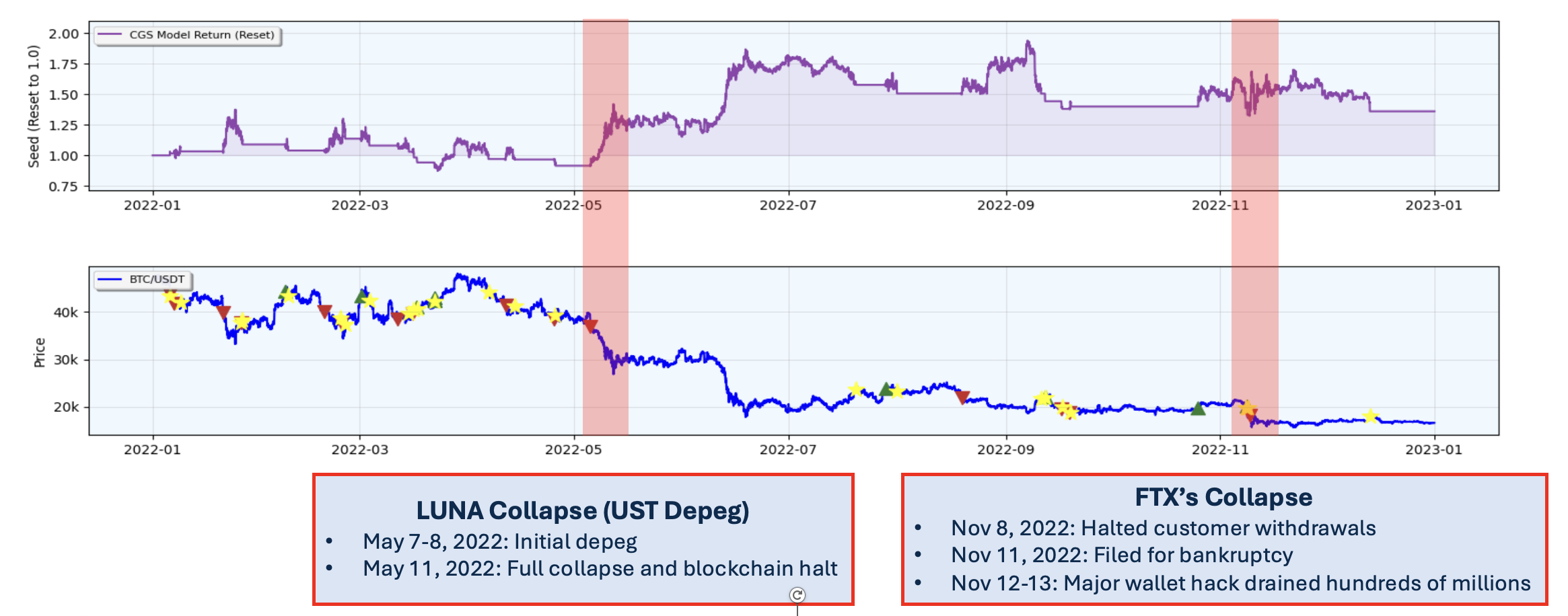
Risk Control Examples: Comprehensive overview of risk management features including stop-loss mechanisms, position sizing algorithms, exposure limits, and portfolio-level risk controls
Key Risk Control Features Demonstrated:
- Stop-Loss Mechanisms: Automatic position closure at predefined loss thresholds
- Position Sizing: Dynamic position sizing based on volatility and account balance
- Exposure Limits: Maximum portfolio exposure controls per asset and strategy
- Correlation Management: Portfolio diversification to reduce correlated risk
- Real-Time Monitoring: Continuous risk metric calculation and alerting
- Circuit Breakers: Automatic system shutdown for extreme market conditions
License
Copyright (C) 2025 CGS Engine Inc, All Rights Reserved
Contact
For questions and support, please open an issue in the GitHub repository.